
A New Media Channel. By Fans, For Fans.

Tuesday, July 21, 2026

The Odyssey (2026) vs. The Odyssey (1997) [Spoiler Review]

For this particular film review, we're going to do something a little bit different. 

We decided to compare the Christopher Nolan star-studded blockbuster The Odyssey to an adaptation our co-writer, Mallika, was exposed to when she first read the epic poem in ninth-grade English class. This adaptation was a miniseries released in 1997 on NBC, and it too featured an all-star cast with names including Armand Assante, Isabella Rossellini, Bernadette Peters and Vanessa Williams. 

The differences between the two feel inherently obvious, at first. The production value for the latest adaptation is clearly much higher, being that the miniseries aired on network television in the '90s. The miniseries is told in a sequential order, while Nolan's is intentionally depicted in a nonlinear narrative to showcase the total impact Odysseus' time fighting in the Trojan War has had for decades. Moments in the miniseries feel cheesy, such as when the character of Telemachus is born, or when Odysseus (Assante) flashes back to memories with his wife, Penelope (Greta Scacchi). But, if you examine these two depictions closely, you realize that they do indeed reflect the original source material well. 

For starters, both amount to a similar runtime, showcasing a true devotion to the material. 

Considering the miniseries was made in the '90s, the action sequences look good. They may not be at the level of Nolan's, but even sans-IMAX, they made an impact. 

The boats surprisingly do look fairly similar. Maybe Nolan's are more prestigious-looking, but both depictions do a good job capturing the grandeur of these water-crafts. Eddie expects Assassin's Creed videos featuring Nolan's boats to flood YouTube very soon.

When the Cyclops arrives in the miniseries, there are some clever wisecracks thrown around by Odysseus. Humor actually is more prominent in the miniseries. It would have generally been nice to see more humor in the Nolan version, but it captures you so fully with its action sequences that it leaves you immersed the whole time. What would be interesting is an alternative cut of Nolan's told in sequential order, just to see how different the storytelling would be. Other than that, it generally needs no notes. 

In the miniseries, we see Greta Scacchi as Penelope do her best to keep the kingdom of Ithaca alive without a king, while pining for that very king (her husband) to come home. Anne Hathaway's Penelope has a similar arc, though as an actress, she is given more expressional range. Both are trying to ward off suitors' advances, including those from Antinous (played in the Nolan version by Robert Pattinson, in a deliciously wicked performance), but Hathaway is more savvy in how she handles this. Also, brace yourselves for an epic faceoff between him and Odysseus at the film's denouement. 

There is noticeably more sexuality in the '90s miniseries, which feels on par with that era. In fact, the Nolan version is so devoid of sexuality, it makes me wonder why it was rated R in the first place. The sirens are depicted from a surprising distance in his version, but it's incredibly effective for the film. The violence, though apparent, doesn't feel as intense as in "Gladiator," for example.

The costumes in the '90s miniseries, surprisingly, feel more accurate to the time period (save for Telemachus - who is played by Alan Stenson - and his '90s hairdo). While much has been made about the historic inaccuracies in Nolan's version, you still get a sense of being transported to Ancient Greece, and moreover, his depiction is meant to evoke the feelings of being alive during that time, providing an analog to the threats of civilizational decay we face today. 

Both Odysseys | Copyrights NBC-Universal/Comcast 2026 and 1997, respectively

In typical '90s fashion, men behave like men throughout the miniseries, with little recourse for their actions. There is a much-needed update in Nolan's version, where Odysseus is often reflective and introspective about his time at war, particularly in his scenes with diabolical nymph Calypso (Charlize Theron). It's clear that Nolan is depicting the toll of war throughout his iteration, and this film might be a sequel of sorts to his Oscar-winning hit Oppenheimer, with its meditation on the consequences of war. You don't need an inner-monologue akin to Assante's narration in the miniseries to work out what Damon's Odysseus is thinking.

Speaking of men-will-be-men narratives, the men in the miniseries engage in more debauchery and bacchanalia, while Nolan's troops behave like stoic, yet reflective, soldiers throughout. It makes the warcrimes they, and Odysseus, commit during the siege, revealed at the end of the film, all the more shocking.

The Circe scene in the Nolan version is one to watch. A really powerful performance from underrated actress Samantha Norton as the man-hating goddess belies an underlying sadness and sympathy. While it is epic to see how the men are transformed into pigs (literally), there is also a humanity to that sequence that gives it gravitas. 

Both conclude with the slow reveal of Odysseus' return. While Assante's version also arrives as a beggar, there is more context provided to Damon's transformation for viewers. When the big reveal happens, it's much more satisfying in the Nolan version. The miniseries has Assante magically change back into form in a rather hokey manner, whereas Damon's tricks Ithaca's inhabitants into thinking he is truly a beggar who knows of Odysseus's whereabouts, only to reveal over time that he is the real thing.

With a smaller (though big for network TV) budget and network censors against them, the 1997 Odyssey miniseries does its best with what it has. You have to admire the chances it takes with these elements in play. It doesn't hurt that it was produced by Francis Ford Coppola. 

Of the two, of course, Nolan's The Odyssey is the superior one, but both are incredibly faithful to the source material, and deserve the praise as such. 

Miniseries

4/5

Feature

5/5


Share:

Tuesday, July 14, 2026

Directorial Debuts Episode 1: Duel (1971)

Directorial Debuts Episode 1: Duel (1971)


Directorial Debuts is a series by new Why We Watch writer Anthony Carioscia where he tackles the first full length film of famous directors to see if they started their career with a bang, if they had a rough start, and to see if there are any signs of the director’s later style in this debut film length work. 


Before we begin though there will be some rules for these articles. We will be looking at the directors first full-length feature film so this means no shorts, no episodes of TV shows, no co-director works unless the film credits both directors in the director slot, no lost films that are impossible to watch in full, and we will not be counting their non-directing debuts. TV movies are allowed to be factored in though as this first article will be focused on a made for TV movie, the directorial debut of none other than the most famous director of all time, Steven Spielberg's Duel


Duel Poster
Duel Poster Copyright Universal 1971

Steven Spielberg is someone who needs no introduction. Born in Cincinnati, Ohio, Steven Spielberg is from a wave of directors that made their names in the late ’60s and early ’70s known as New Hollywood. This wave of directors changed mainstream Hollywood forever and included other famous directors such as Martin Scorsese, Brian De Palma, Peter Bogdanovich, Paul Shrader, George Lucas, and William Friedkin. Spielberg's biggest contribution to Hollywood would be of course the invention of the Summer Blockbuster with Jaws being such a megahit that it made studios release all their planned blockbusters during the summer. This would eventually lead to mainstream studios putting the control back into their films vs mostly releasing director-driven films, which at the time was common during the New Hollywood era. Spielberg would continue to make some of the most famous blockbusters of all time including Jurassic Park, Indiana Jones, and E.T.  He is also well-versed in making acclaimed dramatic films. It’s something that though he had early examples of, with The Color Purple and Empire of the Sun, they became his usual focus(with exceptions here and there) after the success of Schindler's List.  He also co-founded the studios Dreamworks and Amblin, both which put out many hit films as well as worked as executive producer on several TV shows including the popular ‘90s cartoons Animaniacs and Tiny Toon Adventures and the critically acclaimed war- based mini series Band of Brothers and Pacific. But none of this would likely exist if the man didn't give us a made-for-TV thriller known as Duel


Duel premiered on ABC in 1971 and was written by Richard Mattheson, who also wrote the short story of the same name, which was published in Playboy earlier that same year. This was part of a series ABC would do at the time called ABC’s Movie of the Week. This was a series on ABC where a different made-for-TV movie would premier on that channel every week.  This series would end up producing pilots for popular shows like Kung Fu and Starsky & Hutch as well as several films that have become cult classics such as Trilogy of Terror (also based on Matheson stories), Crowhaven Farms, and Satan's School for Girls. But back to Duel


Duel is about a traveling salesman played by Dennis Weaver is psychotically stalked by a mysterious truck driver. The film has very little dialogue and is mostly told through visuals and we never see who the driver even is. 


Several of Spielberg's later tropes can be seen as well as the potential of the awesome director he would go on to be. Even this early in his career he was showing that he was a master behind the camera with its excellent cinematography. The style of the film is almost of that of a classic monster movie being filmed in a way to give the truck threatening characteristics kind of like what he would later do with the shark in Jaws, and like with Jaws not showing the driver gives a sense of fear of the unknown just like what Jaws would later do with its limited footage of the shark. The style of the film would leave people on the edge of their seats  at home and two years later, it would leave them on the edge of their seats in theaters when it was released widely with 16 minutes of extra footage.


So how does Duel rank with the director's later material? Up there with with the greats, not only is this a good start but it's also his first masterpiece, one of the best TV movies ever made (yes I know that's a low bar…) and is up there with Last Man on Earth, The Omega Man, Legend of Hell House, Stir of Echoes, and the third segment of Trilogy of Terror. If you have not seen Duel, fix that now because you are missing out!!!!


5/5
5/5 Truck Stop Hot Dogs


Share:

Sunday, June 28, 2026

Toy Story 5 (2026) [Spoiler Review]

Primary Disclaimer: Eddie, co-writer of this review, is a former employee of a company that makes premium theater concession products, and he worked there while this movie was one of their projects. 

Secondary Disclaimer: He wouldn't have that job, or be the person he is today, if he didn't see Toy Story in 1995, when he was 3.

It's the sequel we didn't want but didn't know we needed.

Like a lot of people (I would assume), I winced when it was announced that there would be a Toy Story 5.  Years later, I saw the trailer, and I changed my opinion a bit, but still had reservations, as the plot of "Toys vs Tech" could be a simple, but effective, PSA on Disney+. Once I learned Taylor Swift was involved, I was all in. 

My Swiftie heart burst at the thought of hearing her latest No. 1 hit, and the first No. 1 for a Pixar movie, "I Knew It, I Knew You," during an all-timer montage. I left the theater a tad disappointed that I didn't get to see Jessie prancing along to a song written so beautifully for her, but I was happy, so I stayed anyway. 

The song feels like a satisfying sequel, almost, to the Oscar-nominated Sarah McLachlan tearjerker "When She Loved Me" that played in "Toy Story 2," famously. Read on for why that is the case. 

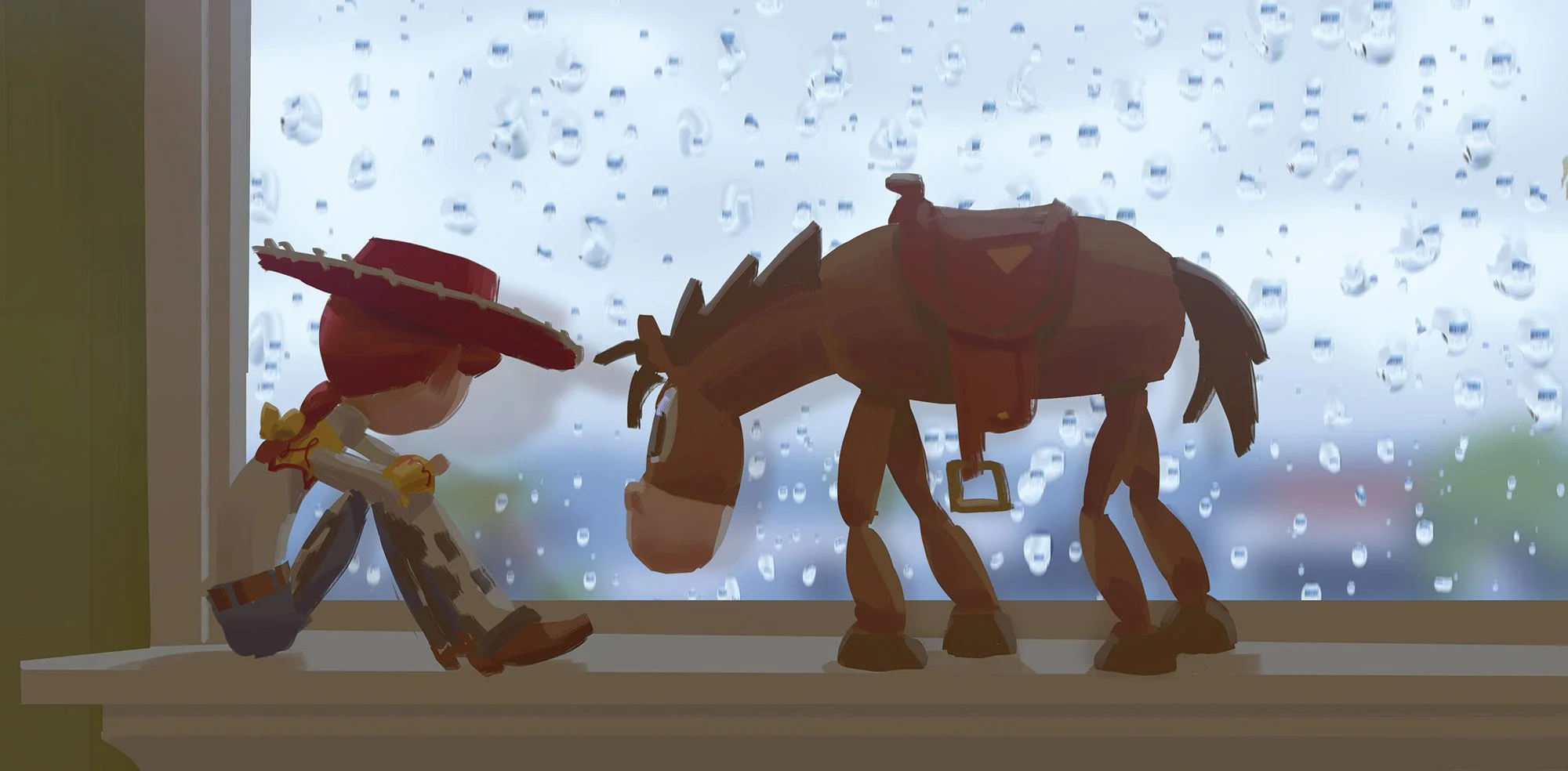
Jessie and Bullseye Concept Art
Jessie and Bullseye Concept Art | Copyright Disney-Pixar 2026

For those who have watched the trailer, you've probably gathered that the beloved gang of Woody, Buzz, Jessie, and the like are dealing with the looming, existential threat of technology. Given how long the issue of kids and technology has loomed, it makes you wonder why it took this long for this series, or any film, for that matter, to address this topic so eloquently. 

The crux of the film's plot surrounds eight-year-old Bonnie's (Scarlett Spears) realization that she can no longer connect with her peers due to being technologically behind. To get her to make friends, Bonnie's parents reluctantly invest in a tablet known as Lilypad (Greta Lee). For those who remember LeapFrog, low-tech Lily-Leapfrogs are, in-fact, a very real tie-in product for kids who are between 5-8. Keep that in mind.

In the short term, Bonnie becomes addicted to the technology and starts exclusively connecting with her friends through it, leaving her beloved toys in the dust.

Bonnie's main toy pal at this point in the series is, of course, Jessie The Yodeling Cowgirl (Joan Cusack). When Jessie senses that she and the rest of the gang are being abandoned for this shiny new piece of technology, she embarks on her own journey to reconnect with her owner. 

While Lilypad may originally present as a villain, she turns out to be a more amiable character than expected, as she is concerned about Bonnie as the rest of the toys are. At first, it makes you wonder why the creators didn't present her as an ominous presence, given how fearful the toys are of technology when they first discover it...then you remember the Leapfrog (and that Pixar's origins are inextricably linked to Steve Jobs). 

Captain Midnight noted this in his review, and thought Lily should go full villain like the big bads of the second and third movie. I'm of two minds here. Basically the movie we got is good filmmaking, but untrue to the real world of tech addiction that we're in. If we were to see Bonnie throw a tantrum because she has her tablet taken away, the movie would be as rough to rewatch as seeing a real kid going through screen withdrawal. I think the solution is not to make Lily the villain, but her manufacturer. Make her default programming be (unknowingly) enabling tech addiction and data harvesting like we know companies like Meta are, and then make her in need of de-programming like Buzz had to be in the first movie. A mix of well-intentioned, as she claims in the actual movie, but harmful to Bonnie.

Woody (Tom Hanks) makes a triumphant return from the fourth film (with a balding head) when Jessie summons him via a walkie talkie to help Jessie find her way back to Bonnie. Then, Jessie and Bullseye stowaway in her suitcase en route to a sleepover with Bonnie's new friends. When Bonnie shows off her toys to her new pals, they all look in scorn, leaving Jessie and Bullseye dejected.

Jessie and Bullseye then find themselves with an elderly couple, who uses the address of Jessie's former owner Emily (get ready to cry) to return the left behind toys. 

For the rest of the film, Jessie essentially goes on a journey akin to the one she experienced in the second film, as she mingles with a group of forgotten toys left in the shed of the farmhouse that Emily once resided in. They include potty training device Smarty Pants (Conan O'Brien-providing the same kind of sarcastic joy we know him for), GPS hippo Atlas (Craig Robinson) and digital toy camera Snappy (Shelby Rivera). She then discovers the human daughter residing in this farmhouse, a young girl named Blaze (Mykal-Michelle Harris), prompting her to introduce Blaze to Bonnie.

The two girls then befriend, allowing Jessie to spend more time in the farmhouse, where she discovers an old lunchbox hiding late 20th-century objects and a photo of an adult Emily with her daughter named (you guessed it, and get ready to cry again).

The film ends with a staged wedding between Jessie and Buzz Lightyear (Tim Allen, who also voices 50 high-tech, and high-flying, Buzzes in "demo and drone" mode) hosted by Bonnie and Blaze, before cutting into a potential future Oscar-winning song in the credits (and credits that feature friendship bracelets for Bonnie and Blaze, naturally). If the Emily revelation isn't enough for you, Woody and the original Buzz "flying in style," surely will make you cry.

While this movie initially seemed unnecessary, it remains as simultaneously poignant and fun as its predecessors. Pixar pulls off the impossible with this film, a sequel that manages to match what came before. If we must have a Toy Story 6, as the box office demands, hopefully they do the same the next time around.

4.5/5


Share:

Sunday, June 7, 2026

Why We Watch Showcase

Almost a year since my last post, and almost halfway through the year, and it's been nice and quiet here...
Part of that is because of work and a ramping up life at home, there's also been a redirection of artistic efforts. 

Santa Hat Candy Bowl

I've been doing a lot of 3d modeling and uploading to BlendSwap. That site recently got a wonderful redesign, and that inspired me to create a showcase page for all the Blender work and some miscellaneous graphic designs I've made for fun. So, please see this new page and start with the Blender tab and my BlendSwap profile. It's also linked at the top of the site, next to the even more impressive Guest Work page. Note: Everything was made prior to BlendSwap's AI Studio launch.

Share:

Sunday, July 20, 2025

Superman (2025) [Spoiler Review]

Primary Disclaimer: I work for the company making some of the premium theater concession products for the movie. 

Secondary Disclaimer: Mallika Rao, my girlfriend, co-wrote this review. 

David Corenswet isn't a god, he's just excellent at playing a man often mistaken for one. James Gunn, however, may be a god.

His take on Superman is an exhilarating ride through the journey of one of America's biggest icons, as he rises, falls and rises again. It’s practically a religious experience to witness Krypton’s best take to the skies and take down the bad guys.

In James Gunn's Superman, when the title character (David Corenswet) puts himself front-and-center in international conflict, the domestic fallout is greater and more far-reaching than he could have possibly imagined. 

Superman, a.k.a Clark Kent, stops a foreign invasion from the fictional U.S. ally Boravia into the poorer neighboring fictional country of Jarhanpur after losing his first fight to the mysterious "Hammer of Boravia." This seemingly heroic act receives swift backlash, which is only compounded by his and the world's discovery of a leaked video message from his birth parents in Krypton, which includes invasion sentiment from patriarch Jor-El (Bradley Cooper, in a surprise cameo).

The movie also features some of the usual cast of characters, including Lois Lane (Rachel Brosnahan), Lex Luthor (Nicholas Hoult), Jimmy Olson (Skyler Gisondo), Perry White (Wendell Pierce), but also introduces a multitude of DC superheroes like Mr. Terrific (Edi Gathegi), Guy Gardner's Green Lantern (Nathan Fillion), and Hawkgirl (Isabela Merced). It is written and directed by James Gunn, and it's edited down to 129 minutes --  an unprecedented pace for a Superman movie -- by William Hoy and Craig Alpert. 

In preparation for the movie, I've been listening to a series from one of my favorite podcasts Blank Check on their Patreon page covering the Superman franchise. I also recently rewatched Superman Returns and Man of Steel, having rewatched Richard Donner's first Superman a few months ago.

One of the things they covered on the Blank Check series was how slow the arc of Superman's story is in previous films. James Gunn's Superman counters this trend by keeping things at a brisk pace, and the audience is strapped to that speeding bullet from the beginning. 


Superman Poster
Theatrical Poster | Copyright 2025 Warner Bros./DC Studios

There are moments where the audience is reminded of why Gunn is a genius at the superhero film genre. Elements of the Guardians franchise are present throughout the film, from the needle drops, to the remote-piloted drone combatants that were also a key component of Guardians Vol. 2.

Also present is the strong emotional center that is at the core of Gunn's previous work, if not more so. This is especially apparent with the pairing of Lois and Superman. While there are rarely scenes with Superman's beloved alter ego, one of the finest moments in the film is an interview scene with Lois and Clark. 

It's been well-documented online how smoothly Brosnahan and Corenswet's chemistry test went, and the evidence is clear in this scene. This might be the strongest display of chemistry between actors in this genre in the last decade. 

It all culminates in their first flight on-screen together, which sadly is left too close to the end but still maintains the thrill of scenes like it in previous films.

What also struck me is how well DC's most beloved couple plays in a staff room at the Daily Planet. This is a less meek, put-on Clark than we typically see in live-action. It's primarily communicated with his glasses and tousled curls, and less in his voice and actions. He's not bumbling and he's able to hold himself in a room, so there are less glances at his and Lois's way when people are wondering how they become a romantic match. It also nicely blurs any debatable dividing line between Clark and Superman. When you start from either place, that's just him.

One element of the Superman films that has always struck me is his origin story, though I’m more simpatico with Spider-Man...the scrawny kid in school who didn't really gain confidence or find his place in the world until college. When I see Sally Field's Aunt May, I see my mom. My dad and Cliff Robertson’s Uncle Ben can paint kitchens together for their wives. And I didn't meet my biological parents until 2022, so it's funny that in 2025, I've shifted from one hero to another because now there’s a movie where all four of my parents are essentially on-screen. 

What got me was that leaked video featuring Jor-El and Lara. When shown in full, the message they leave for Kal-El essentially says to exert his full force over the humans. As YouTuber Troyoboyo17 states, "Kal-El was sent to rule over Earth, repopulate it as a new Krypton." Many fans like him have called this character assassination of Jor-El and Lara...I'd argue it's re-interpreting the characters for this generation...and for myself.

Another thing I saw in 2022 was The Batman by Matt Reeves. That one played with the Wayne legacy a bit with Thomas Wayne nearly aligning himself with the mob to protect his wife. Three years later, we have a House of El that aligns closer to Man of Steel's Zod, putting the continuation of their lineage and species above all else. Even if these are separate universes, this now isn't unprecedented in this series of movies from DC Studios. It reminds me of the most extreme cases of narcissistic parents who still believe that what they're doing is for their children.

To make a long story short, my adoption became a cloak-and-dagger situation with revelations that are actually more in-line with Spidey. On that note, Spider-Man: Family Business, the one with Peter's sister Teresa, is a reviewed recommendation of mine. 

Now, what happened to me was the right thing to do in the moment to just make sure I was going to be okay. Basically, some significant members of my biological family never knew about me until the tail end of the pandemic. It was absolutely not the lie to maintain for decades. With all family members now known, we'll one day pick up the pieces.

To that end, I had some hope as I watched how the revelations in Superman that once damaged Clark's relationships with the world and his friends, are put in perspective through the grounding of who he knows, loves, and trusts, such as his adopted parents the Kents.

With the Kents, we have the lovely Kansas couple Ma (Neva Howell) and Pa (Pruitt Taylor Vince). Vince delivers a comforting, though standard message that your choices and your actions make you who you are. But it's the line Pa Kent says before that sticks out. 

Parents who do it right give their kids the tools and support to just go out there and see what sticks. Even if that kid wants to go to college four hours from home, fresh off scoliosis surgery, and pursue fine art with his stick figures...Good parents will point out that the writing about trying to get those stick figures to look like Bugs Bunny or move like The Iron Giant are something worth zeroing in on. But I'll finally digress back to my review of this movie.

As I took in a second viewing of the film, I noticed little details in the writing and execution that built on political themes laid out in the plot (which have gotten a lot of attention online). For example, Lex Luthor is portrayed as a tech tycoon hellbent on world domination (sounds familiar?). 

Even more reminiscent of Elon's recent government takeover was his interactions with the Department of Defense (not to mention that random teenage boy who's on his staff somehow). There are also Zuckerbergian elements at play, as Luthor maintains an army of monkeys akin to Russian bots. 

Keep in mind that the script was written probably around three years ago, before the current events that eerily cross your mind as you watch certain moments in the film. That means the script was drafted before the Oct. 7 attacks in the Middle East, the 2024 U.S. presidential election and the ensuing immigration attacks that it transpired. While themes in the film feel incredibly true to reality today, this is a testament to the filmmakers' ability to be prescient on national and global affairs. 

That said, while the film reads as a political manifestation, it is so much more than that. It is a meditation on kindness at a time where it is sorely needed. 

4.25/5


Share:

Tuesday, March 26, 2024

Ghostbusters: Frozen Empire (2024)

Primary Disclaimer: Eddie works for the company making the premium theater concession products. 

Secondary Disclaimer: Eddie and I are both huge Paul Rudd fans. 

As the latest installment in the Ghostbusters franchise, Ghostbusters: Frozen Empire mostly delivers. There are several callbacks to the original film, more appearances from the O.G. cast and way more screen time for the always wonderful Paul Rudd. 

This time, director Gil Kenan (Monster House) has the daunting task of maintaining one of the most iconic franchises of all time. He takes over for O.G. director, the late Ivan Reitman's son Jason, who helmed the previous film, Ghostbusters: Afterlife. Kenan's horror and comedy backgrounds lend itself to the series quite nicely. 

While pacing is problematic throughout, making an under two-hour feature feel closer to two-and-a-half, Kenan makes sure to stay as true to the original film as possible, unlike Afterlife, which went the traditional reboot route of making a beloved film incredibly dark. 

Theatrical Poster
Theatrical Poster | Copyright Sony 2024

This film follows the Spengler family as they leave Oklahoma behind and decide to resurrect the Ghostbusters proper in NYC, making the iconic Tribeca firehouse their own. Joining them is Rudd's Gary Grooberson, who this time has top billing after spending too few scenes in Afterlife, and is now official with Spengler matriarch Cassie (Carrie Coon). 

Together, they uncover many more supernatural beings, with kids Trevor (Finn Wolfhard) and Egon doppelganger Phoebe (McKenna Grace) having particularly memorable encounters with ghostly creatures. A robust supporting cast including Kumail Nanjiani and Patton Oswalt add a sense of freshness to the series, and this is on top of some very welcome lore building developed by Kenan and Reitman.

The supernatural elements expand past ghosts into things that are borrowed from other creative works, like Avatar: The Last Airbender, but still feel like welcome additions to this world. And some of them spark a well-earned, yet so-so arc for Phoebe.

Her character just feels really jerked around this movie. It gives Grace a lot to work with, and leads to some fine acting from Rudd opposite her, but it's a bit like how Ghostbusters 2 was a bit of a "back to square one" after the classic. That is what makes the runtime feel more padded than it actually ends up being. Speaking of the first two movies...

There, of course, is the return of Dan Ackroyd, Bill Murray, Annie Potts and Ernie Hudson, who this time around get way more screen time. Hudson and Ackroyd especially have memorable arcs, with Hudson's Winston Zeddemore going from a trusty driver to a renowned philanthropist and Ackroyd's Ray Stantz as a podcast host of (what else?) a supernatural show! Potts, meanwhile, gets to step out of her comfort zone from zany secretary to kick-butt Ghostbuster Janine Melnitz. 

The butt-kicking and action is pretty strong as well, as improvements to the Ecto-1 take traversing the New York City streets to new heights. It's brief, but seeing the car whip around with a Proton Pack tearing up the town shows how much promise was in this movie, and how much promise is still left in the franchise. They just need to keep experimenting and testing things out...you know, like scientists.

3/5


Share:

Monday, March 18, 2024

Kung Fu Panda 4 (2024)

Sixteen years after first gracing our screens, Po the Panda (Jack Black) is back in action again, this time with a smaller budget and less things to do.

Luckily, the thrills of the original Kung Fu Panda are alive and well. Action sequences in the fourth installment of this franchise totally deliver, and Black brings his best "rizz"-y self to one of his most famous characters, so audiences will still feel suckered into Po's world even if the story wears thin and the laughs are not as monstrous as in previous iterations.

This time around, we watch as Po receives a promotion of sorts from Master Shifu (Dustin Hoffman) to be the spiritual leader of the Valley of Peace. This means that Po has to radically transform from the kick-butt Dragon Warrior to the decidedly more zen philosopher of his kingdom and find a successor in his place. 

Theatrical Poster
Theatrical Poster | Copyright 2024 DreamWorks Animation/Universal

While trying to find the right animal for the job, Po comes across a slick fox named Zhen (Awkwafina) as she tries to steal ancient weapons. Po rightfully puts her in the slammer, only to free her after leopard villain Tai Lung (Ian McShane, reminding longtime fans why he's one of the best animated movie villains) returns and has decimated an entire village. It is then revealed that Tai Lung's return was spurned by a new villain named the Chameleon (Viola Davis, bringing her best to the role). 

Now, onto what makes this movie fall short. If the plot sounds familiar, that might be because parts of it appear to be lifted from the third one. It feels like a regressive retread of Kung Fu Panda 3 overall. Po came out of the third movie ready for a more hands-off role as a teacher, and the fourth opens with him seemingly forgetting this and again asking Shifu why he should step aside as a fighter. This may be because of last-minute editorial decisions that were made by DreamWorks executives.

It was revealed recently in an interview that the film's co-director Stephanie Ma Stine had a more redemptive storyline for Tai Lung, where he and his adoptive father Shifu reunite. However, that plotline was axed by director Mike Mitchell, who ultimately received full credit for directing the film, in a move that probably adds insult to injury for Stine and female directors everywhere. 

Stine also reported being kicked around by film executives, which has been a worrying trend in the movie business as of late.

Then there's the budget, which at $85 million, is decidedly lower than the previous three films, each of which were around $130 million. This might reflect on some of the editorial decisions that were ultimately made in this fourth installment, most notably the near-absence of the Furious Five and their A-list voice cast. Luckily, it looks like no corners were cut when it comes to the stunning visuals that this series continues to dazzle us with four films in. Fight scenes remain as kinetic and inventive as other, with a notable overwater bar brawl being a highlight of the entire franchise.

While Kung Fu Panda 4 has already made more than its budget, with a gross thus far of $176.5 million globally, the box office returns appear to candy coat the film's many flaws. Even still, it's an enjoyable ride with a fan favorite at his kick-butt best. And a thrilling musical number closing out the movie (which we swear is not a total spoiler). 

3.5/5


Share:

Monday, March 11, 2024

Dune (2021) and Dune: Part Two (2024) [Spoiler Review]

For the first time last week, I got sucked into the world of Dune

It is for this reason I decided to review both Dune and the newly released Dune: Part Two this week.

In case you don't know, director Denis Villenueve, production company Legendary Pictures, and studio Warner Brothers chose to divide Frank Herbert's 1965 novel Dune into two parts. While this may have been a gamble, it sure paid off. 

Both films follow the journey of Paul Atreides (Timothee Chalamet), the son of aristocratic leader Duke Leto Atreides (Oscar Isaac) and Lady Jessica (Rebecca Ferguson), a member of the cultish sisterhood known as the Bene Gesserit, who possess strange, mystical powers through years of physical and mental training. 

Because of the rivalry between his and the Harkonnen family, a group of mostly bald, anti-social people, Paul is a bit of an outcast, which is why the idea of him being the heir to his kingdom known as Arrakis poses a threat.

In both films, Paul leads a fight against the Harkonnens over "spice," a commodity analogous to oil that increases vitality and awareness and has psychotropic properties. He finds key allies in the Fremen, a group of poor, Bedouin-like people. 

The rather skinny Paul undergoes Jedi Master-like training in the first film from the likes of soldiers Duncan Idaho (Jason Momoa) and Gurney Halleck (Josh Brolin), physician Dr. Wellington Yueh (Chang Chen) and military strategist Thufir Hawat (Stephen McKinley Henderson), all associates of his father. 

Arrakis is eventually conquered by the Harkonnens in the first film, leading Paul to officially be taken in by the Fremen, along with his mother Jessica. Father Leto ultimately sacrifices himself in a duel with Baron Von Harkonnen (Stellan Skarsgaard). 

Dune: Part Two Poster
Dune Part Two Poster | Copyright 2024 Warner Brothers and Legendary Pictures

Cut to the second film, where Paul has taken up with a mysterious young female member of the Freman named Chani (Zendaya), who appeared to him in visions in the previous film. 

With the House of Atreides officially disbanded under the leadership of another monarch named Emperor Shaddam IV (Christopher Walken), and he is disheartened over the news that Paul might still be alive at the beginning of the film. 

Jessica replaces the head of the Bene Gesserit after its Reverend Mother passes away by drinking the Water of Life, a poison designed for non-pregnant women. She transmutes the poison to her son, only to have him fall into a deep coma. After awakening with the help of Chani, he starts having visions of his stillborn sister Alia (Anya Taylor-Joy in a fabulous, uncredited cameo) and recognizes that he is part-Harkonnen after the revelation that his maternal grandfather is Baron Von Harkonnen. 

Speaking of the Harkonnens, we are introduced to one of its most interesting family members, the sociopathic Feyd-Rautha (Austin Butler, in a performance that would make the late Heath Ledger proud). Butler commands the screen much like he did as Elvis Presley, although in a manner that is less welcoming and inviting. He is, by far, the standout in Villenueve's second act.

That is all I am willing to divulge about this most recent film. If you haven't read the classic novel, you're just going to have to spend nearly three hours watching the glorious battle sequences and imagery, all expertly shot by Villenueve and cinematographer Greig Fraser (The Batman). 

Villenueve, Jon Spaihts, and Eric Roth have somewhat mastered the art of modern blockbuster filmmaking, subverting without winking. What rung out during the second film's trailers by Chani is, "this prophecy is how they enslave us!" 

The Chosen One Narrative that has driven fiction forever seeped and spread into our very real world thanks to how much smaller it has become. Now, it's become Main Character Syndrome, celebrity, and politics propping up actual figureheads. In Dune: Part Two, it's Paul's reluctance for power slowly subsiding as he as continuously looked toward for guidance at the critical time of young adulthood and during unprecedented times. This is delicately explored and it looks like, once again, that story is only just unfolding. 

All I will say is what I unfortunately left out of my initial thoughts on both films: that Villenueve is a master at sucking people into rather complex sci-fi. Even if you have to Google more finite plot details afterwards, he takes you on a ride you wish never ended, even with the rather long run time of each film. The good news is that a film based on the next book in the Dune series, Dune: Messiah, is on the way.

4.5/5


Share: